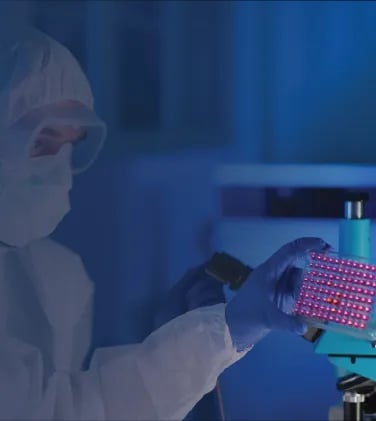
Rotational Clinical Training: Gain practical experience in AERB-approved pre-clinical and clinical nuclear medicine facilities throughout the program.
Research and Development Exposure: Develop skills in radiochemistry, radiopharmaceuticals, and innovation in nuclear medicine techniques.
Interdisciplinary Knowledge: Integrate concepts from medicine, biology, pharmacy, and nuclear physics for a comprehensive skill set.
Global Standards Compliance: Learn procedures that meet international guidelines for radiation safety and patient care.
Professional Development: Build communication, teamwork, and ethical practice skills for multidisciplinary healthcare environments.

Lab Work
Type-II AERB-approved unsealed radioisotope laboratories and clinical facilities at Kasturba Hospital.
Lab Work
Type-II AERB-approved unsealed radioisotope laboratories and clinical facilities at Kasturba Hospital.
Program Details
Master fundamental and applied concepts in radiopharmacy, scintigraphy, PET-CT imaging, and therapeutic nuclear medicine.
Develop strong clinical, practical, and research skills in hospital and nuclear pharmacy settings.
Enhance your ability to design and execute research projects, including the development of new radiochemicals and radiopharmaceuticals.
Inculcate professional ethics, effective communication, and teamwork skills required in interdisciplinary healthcare environments.
Become proficient in problem identification, assessment, and solution implementation using evidence-based approaches.
Participate in continuous learning to advance your career and contribute to societal health through nuclear medicine applications.


Our meaningful collaborations with industry leaders and global universities enhance your career opportunities and higher education pathways.
Placements


Admissions Path
Weightage for preparation of Merit List
MET score - 50%
10+2 examination marks - 50%
Subjects Considered for Preparation of Merit List
Physics + Chemistry + Biology + English in 10+2
Program Eligibility
Pass in 10+2 or equivalent with Physics, Chemistry, English, and Biology from a recognized Board, with minimum 50% aggregate marks in PCB
Physics, Chemistry and Biology in ‘A’ levels and English at ‘AS’ level OR Minimum 5 passes at IGCSE/ GCSE or GCE ‘O’ level examinations including English. Minimum requirement is an average of ‘D’ grade in PCB. Candidates are advised to check the minimum grade requirements for registration in their respective countries
# University of Cambridge GCE ‘A’ Levels / Edexcel GCE ‘A’ Levels / British Examining Bodies
a. Candidates who have completed 10th Grade of Indian Board and completed GCE Advanced Level (‘A’ Levels), should have minimum 3 subjects at GCE Advanced Level (‘A’ Levels) and English at the Advanced Subsidiary (AS) Level
b. Candidates are advised to check the minimum grade requirements for registration in their respective countries
NOTE: The minimum age for admission shall be 17 years on or before 31st December of the year in which admission is sought.
Curriculum and Fees
In the BSc in Nuclear Medicine Technology program, you build a foundation in basic sciences, including Physics, Chemistry, Biology, and introductory human anatomy and physiology. Core courses in medical imaging principles and radiation safety introduce you to the fundamentals of nuclear medicine.
Program Duration
Total Program Fee (2026 Admissions)
General:
NRI/Foreign:
Note : Fee structure for 2027 admissions will be updated shortly
Scholarships
Manipal Academy of Higher Education (MAHE) Manipal awards scholarship for its Undergraduate (UG) and Postgraduate (PG) students under the following categories.


Related Courses
FAQs